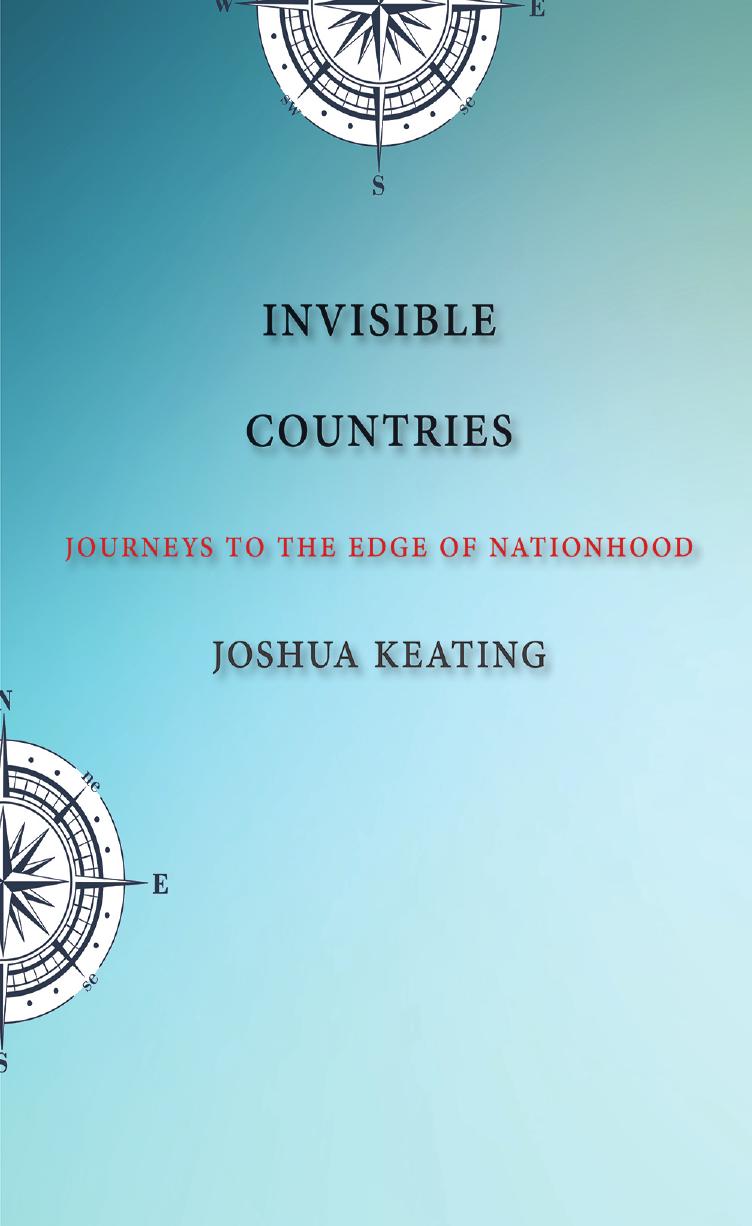
Invisible Countries: Journeys to the Edge of Nationhood by Joshua Keating
Author:Joshua Keating [Keating, Joshua]
Language: eng
Format: epub, pdf
Tags: History, World, Social Science, Human Geography
ISBN: 9780300221626
Google: _xteDwAAQBAJ
Amazon: 0300221622
Publisher: Yale University Press
Published: 2018-01-15T00:39:13.430000+00:00
For all its many serious problems, it is hard to argue with Somaliland’s relative success. Perhaps this is the bigotry of low expectations, but whatever negatives you can say about the place, it’s not Somalia. Over the course of my short visit to the country, I started to wonder if the lack of recognition might have been a blessing in disguise. With little help from the outside, Somaliland has had to do an awful lot on its own, and arguably done it better than many of its recognized counterparts.
“In many African countries that have been recognized, they are still struggling,” said Barwani. “So sometimes we say that maybe being a de facto state is better. Because many recognized states in Africa failed, and they became a one-party system of a dictatorship with no free media and no space for citizen participation. For us, we have so many things. No limitations, no restrictions. Even our neighbor countries, the situation is completely different but they have recognized governments.”
Looking at the decades of support given by the United States to dictators like Mobutu Sese Seko or considering the destabilizing role of Western oil companies in countries like Nigeria, there’s a case to be made that if that’s what engagement with the outside world means for fragile African states, maybe Somaliland has been better off without it. If at some point in the future the world does decide to recognize its independence, bringing with it the attendant investment and diplomatic engagement, Somaliland will be in a stronger and more stable position to handle it. Shire remains optimistic that this day will come. “We’ve waited twenty-five years already. We don’t mind waiting another twenty-five.”
Several months after that interview, Donald Trump issued an executive order temporarily banning travel to the United States from citizens of seven (six in the later amended version) majority-Muslim countries, including Somalia. As the United States still does not recognize Somaliland as an independent country, that means Somalilanders would be banned as well.
Shire gave an interview to NPR in which, in characteristic Somaliland fashion, he took issue not with the intent of the ban itself but with Somaliland once again being punished for Somalia’s bad behavior. “Immigration policies directed at Somalia must not be applied to our country,” he said. “I think we should be judged on our own merits. Have we controlled terrorism? Have we controlled our borders? I think the answer is yes. Do we pose a risk? No.”53
Somaliland is used to being ignored because of its nonrecog-nition. With Trump ascendant and Western governments taking a harder line on countries deemed to be terrorist threats, it could now become more dangerous for Somaliland to be lumped in with its neighbor. Somaliland may no longer be able to afford the patient approach.
Download
Invisible Countries: Journeys to the Edge of Nationhood by Joshua Keating.pdf
This site does not store any files on its server. We only index and link to content provided by other sites. Please contact the content providers to delete copyright contents if any and email us, we'll remove relevant links or contents immediately.
Cecilia; Or, Memoirs of an Heiress — Volume 1 by Fanny Burney(32558)
The Great Music City by Andrea Baker(32018)
Cecilia; Or, Memoirs of an Heiress — Volume 2 by Fanny Burney(31956)
Cecilia; Or, Memoirs of an Heiress — Volume 3 by Fanny Burney(31940)
We're Going to Need More Wine by Gabrielle Union(19045)
All the Missing Girls by Megan Miranda(16023)
Pimp by Iceberg Slim(14506)
For the Love of Europe by Rick Steves(14121)
Bombshells: Glamour Girls of a Lifetime by Sullivan Steve(14073)
Talking to Strangers by Malcolm Gladwell(13370)
Norse Mythology by Gaiman Neil(13363)
Fifty Shades Freed by E L James(13239)
Mindhunter: Inside the FBI's Elite Serial Crime Unit by John E. Douglas & Mark Olshaker(9339)
Crazy Rich Asians by Kevin Kwan(9290)
The Lost Art of Listening by Michael P. Nichols(7506)
Enlightenment Now: The Case for Reason, Science, Humanism, and Progress by Steven Pinker(7311)
The Four Agreements by Don Miguel Ruiz(6763)
Bad Blood by John Carreyrou(6621)
Weapons of Math Destruction by Cathy O'Neil(6279)
